N

newtothis

is it impossible on RCD protected circuits ?
Reason I ask.

I was doing some minor work in my house, spur off ring final.
Turned off applicable MCB, checked at the socket with the voltage tester, no voltage.

Soon as I started conecting the spur the rcd tripped.
I guess this is normal, how do you get around this ?

Adding this
By "get around" I mean is it just something you have to prepare for, inform people etc, or is there some kind of workaround
 
Last edited by a moderator:
common problem. even though the MCB is off, when you short the N to E, the RCD will trip. solution is to either turn off the RCD or be careful when stripping/connecting.
 
Disconnect the neutral from the circuit you are working on in the board as well.

The MCB is single pole so wont isolate the neutral as well. As the neutral bar is common with other circuits, when you make contact between it and earth some current will divert down the CPC and cause the RCD to operate due to imbalance.
 
Many thanks for the replies,
Remove the neutral seems like the way, especially in a nice neatly wired and numbers used board.
How do you mean be careful stripping / connecting ?
Can't think how to avoid RCD tripping, wouldn't it trip when either the N or CPC was connected. Confused dot com LOL
 
it only trips if you short N to E, e.g. when the cpc is bare and flopping about or feeding cable though a hole.
 
it only trips if you short N to E, e.g. when the cpc is bare and flopping about or feeding cable though a hole.
Thanks for the info - I hate finding things out by accident, good job it was my own house :-)
 
I like to pull the earth sleeving up over the end of the cpc, so that if you have equal length conductors the neutral cannot touch the cpc as it is covered at the end of the cable and the bare cpc near the sheath is adjacent to the insulation of the neutral.
Sleeve raised on cable end.jpg
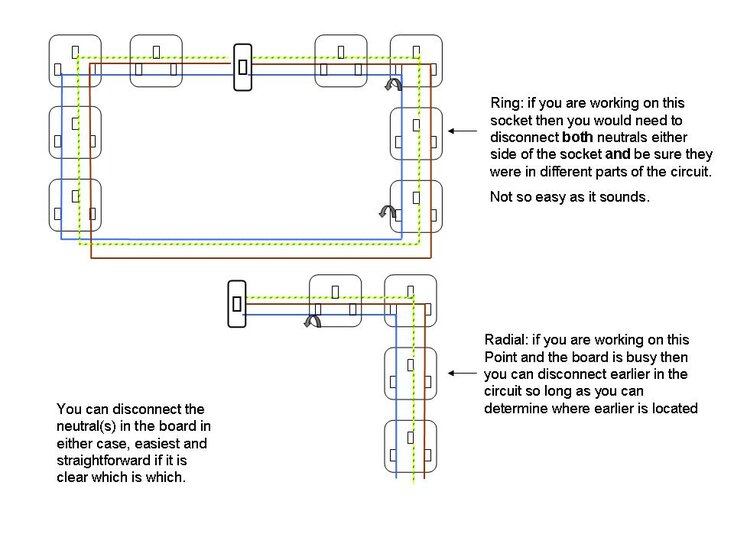
Remember on a radial (or even on a ring, but more hassle) you can disconnect the neutral at an earlier accessible point in the circuit if the board cannot be switched off or is a bit too busy to find the right neutral.
 
i usually fold the cpc back over the cable.
 
Thanks for the great tips.
So just to clarify and get it straight in my head: if I'm working on a ring final I can just locate a nearby socket on the ring and disconnect the neutral. Thinking back, I can see now I have been flapping an earth about.
 
Thanks for the great tips.
So just to clarify and get it straight in my head: if I'm working on a ring final I can just locate a nearby socket on the ring and disconnect the neutral. Thinking back, I can see now I have been flapping an earth about.

Edit: after writing the below, I have interpreted your post in a different way. If you mean, "Disconnect the neutral of the cable I am working on" (at a nearby socket) then yes this would work. But if it's a ring, you'd need to do this at two sockets, either side of the one you're working on... probably easier to do it at the board.

Hi :)

No, you need to disconnect the neutral (radial) or neutrals (if it's a ring final) of the circuit you're working on from the bus bar in the board.

How it works is this:

The RCD has output connections to the line bus (of the circuits it's protecting) and the neutral bar (of the circuits it's protecting). If the current flowing through these two bars is identical it holds, otherwise it trips.

If you have a flapping cpc and it touches the neutral, then that means that current could (and does) flow from the neutral bar, up the neutral of your circuit, from there on to the cpc, from there to your MET and from there to your means of earthing. It's a bit of a circuitous route, but it only takes a tiny tiny fraction of the current flowing to cause the RCD to trip.

By removing the neutral(s) of the circuit you're working on from the neutral bar at the board you are eliminating this alternative path for the current, so the RCD shouldn't trip.

In theory, you could disconnect the cpc (of the circuit you're working on) from the bus bar, instead of the neutral. But this is far less effective, as there are other paths for the current to get from the neutral of your circuit to earth.

Second rule of Steve: "If in doubt, draw it out." :)
 
Last edited:
Love Richard's diagrams! He needs a new badge under his name, something like 'diagram master' or 'visual display expert'.
 

OFFICIAL SPONSORS

Back
Top