M

matt1386

Morning all,

I thought it would be a good idea for us trainees to ask questions between each other to keep things fresh in the head, with help from the pro's if nobody can answer the question you ask

Basically, whoever answers the question, they put the next question up and so on...

Obviously we will all be at different levels so the questions will differ quite a lot

Ok, I will start :


What is the voltage drop across R3 ?

Please show your working out
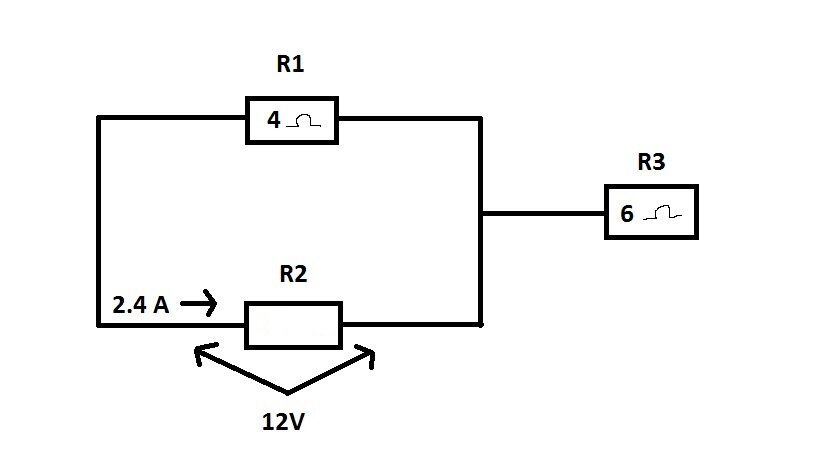
VD.jpg


Matt
 
Great idea! Unfortunately I'd struggle to work that out without looking up the formulas as we've never covered this yet.

I'll be doing some homework over the weekend though so I'll have a go then and post a couple of my homework questions up, were currently doing resistivity, trigonometry and Pythagoras theory stuff

Stu
 
Hi Stu, great stuff !

Yeah Im only 6 weeks or so into my level 2 2365 so im very limited at the minute aswell, will be good to see what different stages people are at and see if we can help each other out aswell

Matt
 
Great idea! Unfortunately I'd struggle to work that out without looking up the formulas as we've never covered this yet.

I shouldn't, but here's a hint...
You only need the most basic/fundamental electrical equation. :-)
 
Don't be put off because it looks to complicated, read the question carefully, decide what you need to do to get the answer then solve it bit by bit.

I'll also give you a clue, well actually 2 clues. You need to apply Kirchhoff's law but you just need to work out the current through R1 first using ohm's law.
 
am i missing something? R3 is not connected to anything to the right, so .....
 
What is the voltage drop across R3 ?

Please show your working out

View attachment 21148


Matt

Right i've just been having a look in my college book and a quick google of a couple of things so i'll have a go...

R3 has me a bit puzzled in the way it is drawn so if i take it as being connected in series then R3 will have a voltage drop of 14.4v ( 2.4A x 6ohms = 14.4v)

Marvos two clues about using Kirchoffs law and finding out the current through R1 makes me think this might not be the case though!
 
Pennychew, wrong!

For starters, what is the current through R1?
Then take it from there.

Assume the left hand side of the drawing is at V[SUB]source[/SUB] and the right hand side is at 0V.
 
IT's good to see you having a bash at it Pennychew. Kerchoff's law would dictate that the current through R3 would equal the sum of the currents through R1 and R2. You've been given the current through R2 in the question so the next step is to work out the current through R1 using Ohm's law.
 
Right then, i was thinking of the circuit as being in series which is all ive seen so far so i thought the current was common but since its in parallel (which i have been reading up on all yesterday!) its the voltage that is common so i can use the 12v drop across R2 to give me the current at R1... so 12v / 4ohms = 3amps through R1

R1 + R2 = 5.4amps at R3

So the voltage drop across R3 is 5.4amps x 6ohms which is 32.4volts (hopefully!)
 
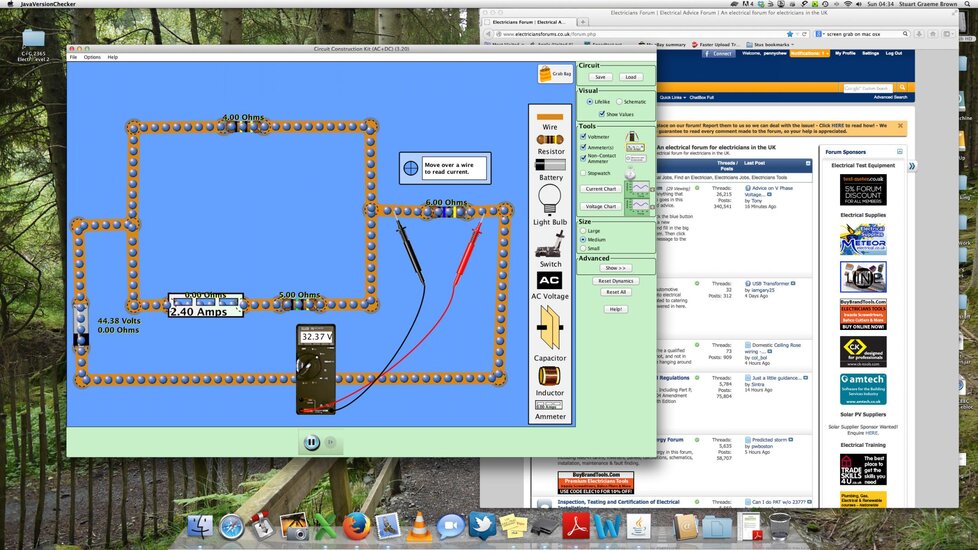
I've built the circuit on a java app called 'Circuit construction kit' which i downloaded a couple of weeks ago which has helped me understand and may be of use to others?

Ive taken a screen grab of it to post up.

Screen Shot 2013-10-27 at 04.34.29.jpg
 
Morning all,

I thought it would be a good idea for us trainees to ask questions between each other to keep things fresh in the head, with help from the pro's if nobody can answer the question you ask

Basically, whoever answers the question, they put the next question up and so on...

Obviously we will all be at different levels so the questions will differ quite a lot

Ok, I will start :


What is the voltage drop across R3 ?

Please show your working out

View attachment 21148


Matt

just for clarification is the 12 the volt drop over r2 or is the 12 the source voltage
 

OFFICIAL SPONSORS

Back
Top