If you are only having a 13A fuse in the plug then you should be using something like HO7RNF3C1.5 all the way so it can handle any fault current, also it might be simpler for ordering and neater to make it all the same.

How you connect and if you need a junction box would depend on the physical details of the lights, etc, and how you plan on laying them out. The dual 13A socket probably has multiple knock-out holes so you can easily wire in to one hole (with a suitable gland) and then daisy-chain out another hole to the lights if you go that way.

It is not clear from the picture of the lights if you could get two cables in to the back of them, or if the internal terminals will take 2 * 1.5mm wire. I guess you would need to buy some to check that sort of detail out.

If you do go for a junction box then make sure it is rated at IP65 or higher, and get suitable glands for it. Again, for all of the outdoor stuff try to have cables come in from below, or sides if you must, but not the top as its an easy way for water to get in.
[automerge]1585323341[/automerge]
Wago do an IP65 box, but bizarrely it is supplied with IP54 cable bushes:
This box is cheaper but you need bushes for any cable:
Here are some bushes that the Q&A says will do 6-12mm and the suggested cable is specified as 9.2-10.7mm so ought to work:
But you can get similar stuff from Toolstation, CEF, etc.
 
depends on the lights. if they have 2 cable entrys, pref. at bottom, then loop through and make connections in the light.
 
If you are only having a 13A fuse in the plug then you should be using something like HO7RNF3C1.5 all the way so it can handle any fault current, also it might be simpler for ordering and neater to make it all the same.

How you connect and if you need a junction box would depend on the physical details of the lights, etc, and how you plan on laying them out. The dual 13A socket probably has multiple knock-out holes so you can easily wire in to one hole (with a suitable gland) and then daisy-chain out another hole to the lights if you go that way.

It is not clear from the picture of the lights if you could get two cables in to the back of them, or if the internal terminals will take 2 * 1.5mm wire. I guess you would need to buy some to check that sort of detail out.

If you do go for a junction box then make sure it is rated at IP65 or higher, and get suitable glands for it. Again, for all of the outdoor stuff try to have cables come in from below, or sides if you must, but not the top as its an easy way for water to get in.
[automerge]1585323341[/automerge]
Wago do an IP65 box, but bizarrely it is supplied with IP54 cable bushes:
This box is cheaper but you need bushes for any cable:
Here are some bushes that the Q&A says will do 6-12mm and the suggested cable is specified as 9.2-10.7mm so ought to work:
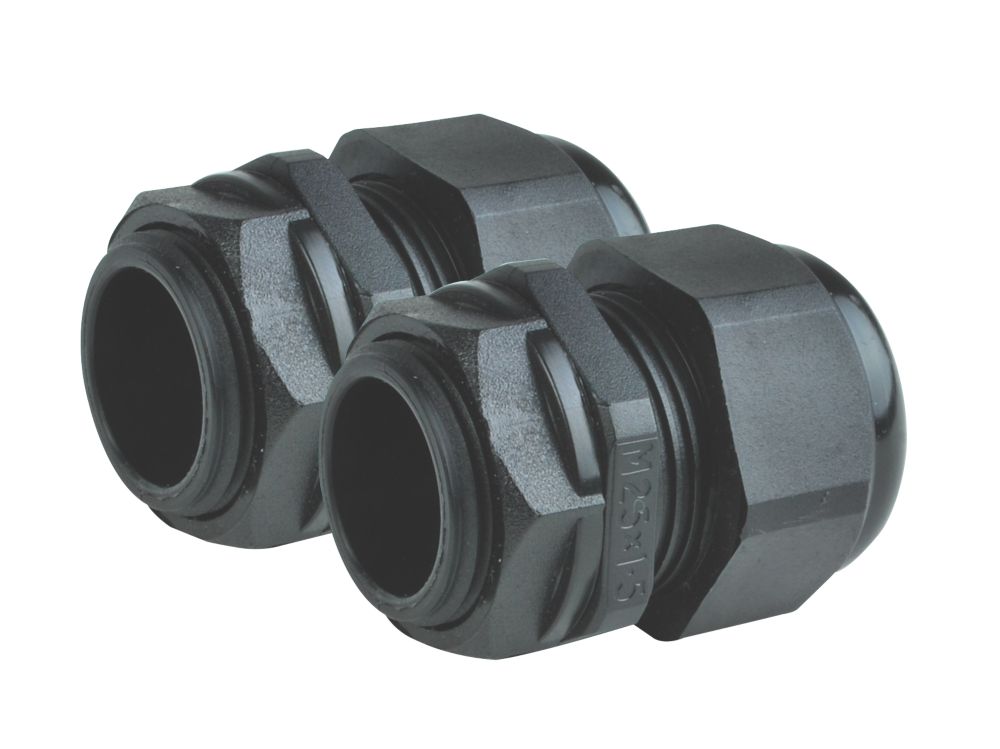
But you can get similar stuff from Toolstation, CEF, etc.
If I run parallel I will defo need a junction box am I correct in saying that? Main feed into the junction box and take 2 feeds out, one to each light?
 
If I run parallel I will defo need a junction box am I correct in saying that? Main feed into the junction box and take 2 feeds out, one to each light?

You might be able to make the junction in one light, but it depends on the physical details of how it handles cable entry, etc. Simplest option with no junction box would be:

13A plug ---> outdoor 13A socket ---> Bulkhead Light #1 ---> Bulkhead Light #2

If that is not practical then something like:

13A plug ---> outdoor 13A socket --->
Junction Box
---> Bulkhead Light #1
---> Bulkhead Light #2

Yes, this is a rubbish way to show it using ASCII art where it wont keep spacing!
No that’s perfect, and understandable, this really is a great forum, quick replies with people willing to help.
 
I have fished in Northern Ireland and the midges are an absolute nightmare consider how many you will attract with your patio lights, factor in a bug repellent on your new circuit.
 
Just to confirm, the upstairs ring that i am connecting into is protected by RCD/RCCB so i will not need an external RCD.

IMG_5388.jpg
 
Just to confirm, the upstairs ring that i am connecting into is protected by RCD/RCCB so i will not need an external RCD.

View attachment 56843
that's a sensible CU. don't allow the scaremongers try and tell you it's now "illegal" as it does not comply with current regs.
 
that's a sensible CU. don't allow the scaremongers try and tell you it's now "illegal" as it does not comply with current regs.

But i am protected which is the main thing, i assume 'illegal' as not up to current regs, but would have been in 2007 when installed
 
But i am protected which is the main thing, i assume 'illegal' as not up to current regs, but would have been in 2007 when installed
exactly. current regs. call for all lighting circuits, cables in walls buried < 2" deep, and all circuits supplying bathrooms. nevertheless it's a bloody good idea to have fridges and freezers non-RCD in spite of the regs...... at home our garage circuit ( 3 freezers, a fridge freezer, sauna, my workbench, all non-RCD, risk assessment in my yed.
 
There was at least one well publicised case of some young woman who was killed by a nail that had punctured a cable and was not picked up by the cowboy installers during insulation testing, one of the arguments for RCD'ing everything you can in the more recent versions of the regs.

But as Telectrix points out there are good reasons to have some circuits on MCBs instead (in terms on not having nuisance tripping). One way round the risk-of-nailing problem is to use Flexishield cable (stuff to BS 8436) that has an earthed metallic shield rated able to trip the MCB, etc, in the event of being accidentally nailed.

Edited to add: as already covered the wiring regs are not retrospective, so as long as your setup is safe and undamaged to the regulations at the time it was installed then no problem. Even if there are issues with a repair or new circuit, the wording of guidance, etc, allows for some judgment to be applied so as long as things are sufficiently safe then you don't need a new unit. What is an issue 15 year or more down the line is getting replacement breakers, etc, that are in good condition. That, as much as anything else, may be the case for a CU replacement (as well as improvements like RCBOs per circuit instead of one RCD for several, etc).
 
Last edited:
There was at least one well publicised case of some young woman who was killed by a nail that had punctured a cable and was not picked up by the cowboy installers during insulation testing, one of the arguments for RCD'ing everything you can in the more recent versions of the regs.
I recall the electrocuted lady incident. I would point out though that if a metal frame partition wall is not at earth potential, which it is unlikely to be if it is simply a standalone wall secured to timber, a standard insulation test may not pick up a fault between a live conductor and the frame. I do not know exactly what testing was carried out or whether the job was properly certificated but I am always concerned that when these kind of incidents are publicised it is always assumed that a cowboy was responsible. There are circumstances where even diligent testing may not pick up a potentially dangerous fault, we are all one mistake away from killing someone. Anyone who thinks only cowboys miss things or make mistakes which could have serious consequences is kidding themselves.
 
There was at least one well publicised case of some young woman who was killed by a nail that had punctured a cable and was not picked up by the cowboy installers during insulation testing, one of the arguments for RCD'ing everything you can in the more recent versions of the regs.

But as Telectrix points out there are good reasons to have some circuits on MCBs instead (in terms on not having nuisance tripping). One way round the risk-of-nailing problem is to use Flexishield cable (stuff to BS 8436) that has an earthed metallic shield rated able to trip the MCB, etc, in the event of being accidentally nailed.

Edited to add: as already covered the wiring regs are not retrospective, so as long as your setup is safe and undamaged to the regulations at the time it was installed then no problem. Even if there are issues with a repair or new circuit, the wording of guidance, etc, allows for some judgment to be applied so as long as things are sufficiently safe then you don't need a new unit. What is an issue 15 year or more down the line is getting replacement breakers, etc, that are in good condition. That, as much as anything else, may be the case for a CU replacement (as well as improvements like RCBOs per circuit instead of one RCD for several, etc).
in the case of the electrocution, i understand that the woman's husband or father fitted a utensil rack after the installation was complete. quite probably with the nail/screw not quite shorting. apparently they had been experiencing shocks for some time before the tragedy. she was in contact with the earted casaing of a dishwaher or similar which was the reason for the fatality. so why had they not called a spark to investigate and remedy when experiencing several shocks?
 
Anyone who thinks only cowboys miss things or make mistakes which could have serious consequences is kidding themselves.

That is a very valid point, and a good reason for taking care in installing, care in testing, and not allowing any "odd result" to be ignored.

I don't know what happened in court, maybe someone on this forum will have read about that, but that case resulted in a prosecution and I doubt very much it would have got that for had it only been a "simple mistake" that led to her death.
[automerge]1585757028[/automerge]
Seems there is a write up here but not much information about the specific issues, though the £1000 fine is quite low suggesting his negligence was not considered major:
More here if anyone is interested, seems a number of factors but not a detailed report on the evidence:
 
Last edited:
If there was a prosecution then clearly negligence was involved. However I would make the point again that it is not a given that standard IR testing as normally carried out will pick up a fault to metal frame partitions and the like.
 

OFFICIAL SPONSORS

Back
Top

