very helpful!
Sorry clearly unlike you I don’t know every detail of every regulation to do with electrics. The guide is produced by the electrical safety council as a guide on classification of c1-c3. I was of the understanding this website was setup for people to pool knowledge not to make derogatory comments
That was not my intention but if you are undertaking this type of work you must have an understanding of fundamental principles for circuit protection and any possible consequences, this does not require knowledge of all Regulations.
 
Usual practice is to make sure you have no metal accessories on the circuit as an immediate measure, and get it rewired at the soonest opportunity.
we have a class 1 fan installed, not my house though. I've told them but "their electrician has said it's fine"
 
That was not my intention but if you are undertaking this type of work you must have an understanding of fundamental principles for circuit protection and any possible consequences, this does not require knowledge of all Regulations.
As the old saying goes you learn on the job. I only passed my exams late last year by no stretch of the imagination do I know absolutely everything about inspection testing and certification as they can’t show or teach you everything in a classroom. I asked on this site because there are people that have been doing the job a hell of a lot longer than me and a lot more experience of dealing with out of date wiring
 
As the old saying goes you learn on the job. I only passed my exams late last year by no stretch of the imagination do I know absolutely everything about inspection testing and certification as they can’t show or teach you everything in a classroom. I asked on this site because there are people that have been doing the job a hell of a lot longer than me and a lot more experience of dealing with out of date wiring
Are you working for yourself.
 
we have a class 1 fan installed, not my house though. I've told them but "their electrician has said it's fine"

Hmmm. I issued a danger notification last week for this very issue. Any landlord is under a legal duty of care to provide and maintain a safe electrical system.
 
Hmmm. I issued a danger notification last week for this very issue. Any landlord is under a legal duty of care to provide and maintain a safe electrical system.
Yup, I've mentioned that. Danger notifications are a little bit out of my remit at the minute. It's rather annoying because I know the dangers and I know what could happen.
 
EICRs is not something you should be learning on the job.
Mate if you’ve nothing to say about the original question then don’t bother answering. I’m not learning eicr on the job but clearly they can’t show every possible situation in college and I don’t know everything like clearly you do.

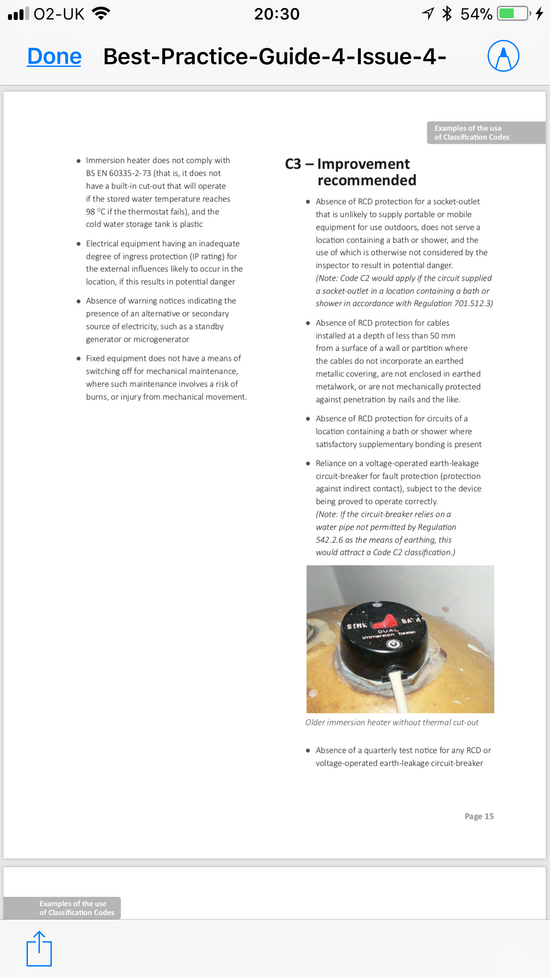
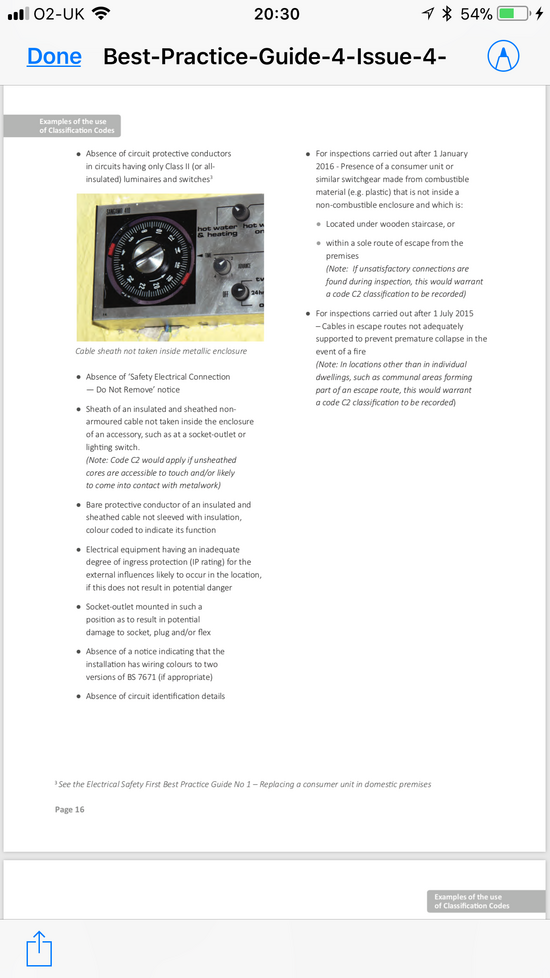
all I was asking was am I right listing it as c3 as classification states

• Absence of circuit protective conductors in circuits having only Class II (or all- insulated) luminaires and switches.

But this thread list c2 due to conduit being present in original question. I just wanted a second opinion for my own piece of mind.
 
If anyone other than the guy above has anything constructive to add ie whether I’m right with it being a c3 or not please comment. If like the guy above you don’t want to answer and just want to argue please look elsewhere as I’m trying to get help answers.
 
1jmz3y.jpg
 
If anyone other than the guy above has anything constructive to add ie whether I’m right with it being a c3 or not please comment. If like the guy above you don’t want to answer and just want to argue please look elsewhere as I’m trying to get help answers.
The code that is applied is the decision of the inspector of the installation as they have the awareness to be able to assess the level of risk caused by the observation.
In the case of the failed conduit a fault from line to the conduit would result in the conduit becoming live, possibly over a large area of the installation.
In the case of a cable installed in an insulating medium this hazard does not arise and so the risk is negligible.
In the case of a normal domestic installation (if such a thing exists) cables are often buried in plaster that, if wet, could provide a potentially partially conductive path, however the likelihood of it being wet may be very low, and so on. All these aspects should be taken into account to adequately assess the level of risk, this can often be done with minimal assessment based on previous experience, occasionally things catch you out.
 
As I replied earlier, C2 as the original CPC has now degraded and is not fit or safe for continued use.

Could be a C3 if no class 1 accessories on the circuit and a note on the DB. However part of the installation could now become live under fault conditions. It’s up to the inspector to judge the risk of human contact during fault conditions with the existing conduit that has poor continuity and to report accordingly.
 

OFFICIAL SPONSORS

OFFICIAL SPONSORS

Thread statistics

Created
Octopus,
Last reply from
Briggs69,
Replies
51
Views
11,454
Back
Top