S
Svenedin
OK. I will ask them.


Haha. Yes I did think it was a rather large fuse! The whole house is built on a massively over-engineered scale. The joists are 9" by 3 1/2 (some 4") and I'm sure they don't need to be. The roof members look like they could hold up a church spire (and as a church bellringer I've seen the inside of many church spires). I've no idea why they did things that way. It's quite a big detached house but not a mansion.
)Yes very true but there can be nasty surprises in old houses. As well as having almost all the water pipes in lead there are gas pipes all over the place for the gas lighting. The fittings on the walls were removed long ago and they were capped off (with a square that can be removed with a spanner). I thought they must be dead and loosened one (very carefully) because I wanted to put a longcase clock flush against the wall and the plug was sticking out. It was still connected! Did that up again pretty quickly. I'll have to get my gas man to cut the gas off under the floor.
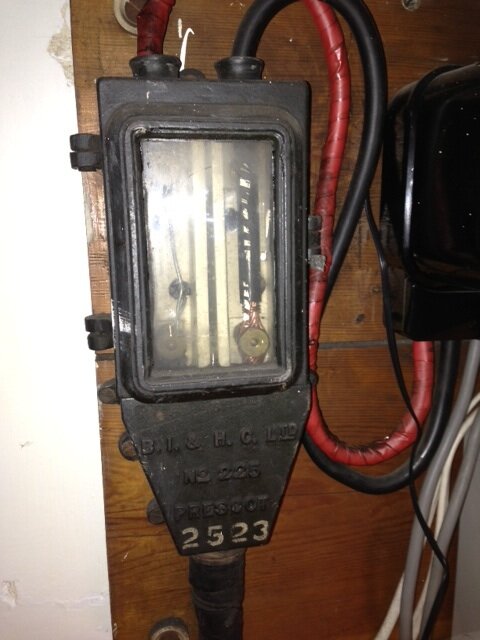
I’ve come across a couple of glass fronted cut outs before. Buxton Derbyshire. They were in buildings supplied from the old three wire DC system.
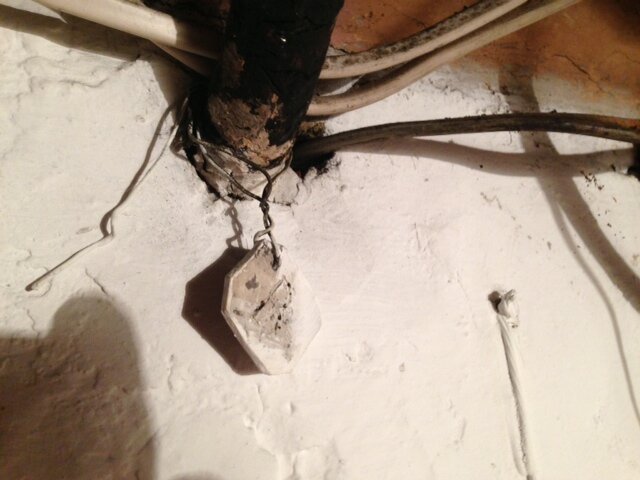
Would be nice to see a couple of photographs, could you put them on PhotoBucket and link to here?

They are all just services that can be permanently removed or renewed!! At least those older houses have decent sized floorboards, and not chipboard sheets...lol!!
Going back to your electrical installation, make sure that all your metallic services (gas/water) are bonded back to the MET, (Main Earthing Terminal) with 10mm earth conductors!! Ideally within 60 cm of entry point into the house, in the case of water, and within 60cm of the meter on the output side for the gas. Alternatively before any of the two service's pipes branches/splits off in various directions...
proper job!
Do you think it's possible that the supply was originally DC ? The last time I saw supply like that was on a private estate in Scotland which had its own generator for the lighting which was installed in the early 1920s.