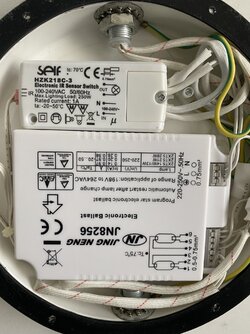
I have a bathroom mirror with 2 x 21W fluorescent T5 tubes and an IR sensor. The tubes switch off after a few minutes. I have changed the tubes and the fault persisted. I checked the output from the IR switch and it was 240V so that leaves the ballast as faulty. The problem is the ballast is a not one of the long ones but a shorter one that fits neatly inside a waterproof compartment. I cant get a replacement ballast so I'm looking for some options. I want to replace the Fluorescent tubes with LED T5 equivalents but UK ones still seem to require a ballast (presumably to make them a straightforward replacement). It seems that the US have type B tubes which will run straight off the mains (that would be an easy option as I could just remove the ballast and adjust the wiring but they don't seem to be available in the UK. Can anyone suggest an alternative? Thanks

- Thread starter jazzlover
- Start date




OFFICIAL SPONSORS
-

Thread 'CheckaTrade | MyBuilder | RatedPeople | TrustaTrader etc - Who's with what and why?'
CheckaTrade | MyBuilder | RatedPeople | TrustaTrader etc - Who's with what and why? Thought I'd start a poll off to...- Admin
- Replies: 96
-

Thread 'Joining a cable to be buried in a wall'
Now and again, I need to join a cable that is buried in a wall, sometimes in a stud wall, sometimes to be plastered...- SJD
- Replies: 58
-
Thread 'Access-only Areas Of The Forum - How Do I Gain Access?'
HOW TO ACCESS THE ELECTRICIANS ARMS The Electricians Arms is the access-only area for professionals working in the...- Admin
- Replies: 14
-

Thread 'Is there a table of expected R1+R2 results in BS7671?'
Evening... I always use my OSG to find R1+R2 when needed for designing a circuit (staying withing the Zs limits)...- HappyHippyDad
- Replies: 25
-
A
Thread 'Checkatrade, Mybuilder, Myhammer ratedpeople etc etc.. Your views?'
Are they amu good as I am thinking if joining and one of their reps is coming next week!! Keep the cash and have...- alexg
- Replies: 232


