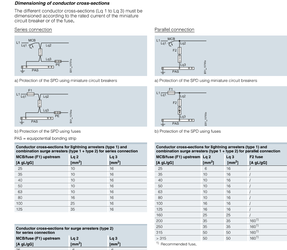
Surge protection will normally site there taking only microamps, until something in the kV region comes along following a lightning strike or major fault on an inductive load and you might have kA of current flowing as it diverts it to limit the voltage, but only for tens of microseconds.
In that sort of case the cable size is trivial from a heating point of view, and what matters more is inductance. Larger diameter (i.e. CSA) helps slightly there. As that normally dominates the impedance when looking at things in the microsecond region cable length and loop-area should be minimised. In your diagrams the "series connection" is all about that, sometimes it is called Kelvin or V-wiring (in this case cable size has to carry normal operating current).
But if something goes very wrong and the SPD disintegrates in to an arc you need to have some for of ultimate back-up. In many cases the supply fuse is enough when it is in the 100A or so region (depending on SPD, etc), but if the supply needs something larger you end up putting in a dedicated fuse or MCB for the SPD.
Generally a fuse is better electrically, as it has less inductance than the magnetic trip coil of a MCB, but for reasonably sized MCB and going for C or D curve, that can be kept to tolerable levels.
So when looking at the "parallel connection" cable size from a traditional circuit protection point of view, it simply has to be sized to meet the adiabatic limits of the OCPD. When looking at 100-160A fuse or 63A-ish MCBs for SPD backup you would be looking at least at 6mm^2 (e.g. Table B4 of the OSG) and in most cases 10-16mm would be a far safer choice.