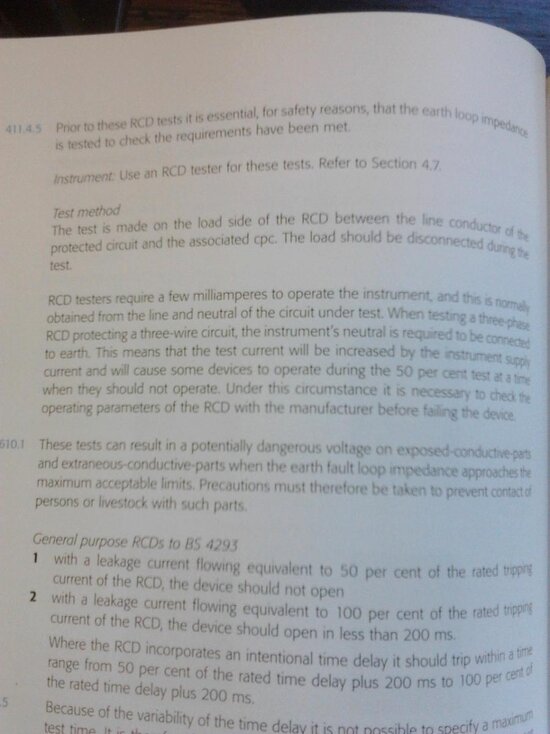
To the best of my knowledge an RCD test should be carried out with the outgoing conductors disconnected.

When I made this very point on the boards.ie Electrical forum the moderator deleted my "incorrect posts" after I refused to. RCD testing seems to be widely misunderstood.

An alarming number of people seem to think there is merit testing an RCD at the extremities of the circuit, completely ignoring the fact that it is the RCD under test and not the circuit.
 
What evidence can you find to say it has to be done your way?
http://electrical.----------/wiring-matters/15/insp-test-rcd.cfm?type=pdf

Last page section .5

Tests are made on the load side of the RCD between the phase conductor of the protected circuit and the associated cpc. Any load or appliances should be disconnected prior to testing. RCD test instruments require a few milliamperes to operate; this is normally obtained from the phase and neutral of the circuit under test. When testing a three-phase RCD protecting a three-wire circuit, the instrument’s neutral is required to be connected to earth. This means that the test current will be increased by the instrument supply current and will cause some devices to operate during the 50% test, possibly indicating an incorrect operating time. Under this circumstance it is necessary to check the operating parameters of the RCD with the
manufacturer before failing the RCD.


Guidance note 3 also states the same in similar words as the PDF and guidance note 3 are written by the IET.
 
Last edited by a moderator:
So it saying any load or appliances disconnect can mean you can at a socket but with everything disconnected ect
 
What evidence can you find to say it has to be done your way?

Just think about it for a minute!
What are you testing?
Why are you testing it?
What effect will a less than perfect IR have on the test?
Could the capacitance of the cables have an effect on the test?

What would be the implications of the above if they did affect the test?
 
it's in GN3 . Not a clear pic , but you will get the gist of what Dave is saying.
 

Attachments

  • 2015-07-19 15.27.33.jpg
    2015-07-19 15.27.33.jpg
    91.3 KB · Views: 216
Then you are not carrying out the test correctly!
RCD tests should be carried out at the outgoing terminals of the RCD with the outgoing conductors disconnected.

Perhaps you should revise your test procedures a bit before carrying out any more testing.
I understand your hypothesis for testing an RCD (i.e. just testing the RCD only), but how do you do that in the case of a dual RCD CU, without having to deconstruct the bus bars etc? You would also be carrying out an unnecessary live test, with the CU cover removed, when the test can be carried out at a socket without exposure to live parts, unless I'm not understanding you correctly. Why would manufacturers supply such test leads?
 
I understand your hypothesis for testing an RCD (i.e. just testing the RCD only), but how do you do that in the case of a dual RCD CU, without having to deconstruct the bus bars etc? You would also be carrying out an unnecessary live test, with the CU cover removed, when the test can be carried out at a socket without exposure to live parts, unless I'm not understanding you correctly. Why would manufacturers supply such test leads?

In a CU the outgoing ocpds can be switched off to disconnect the outgoing circuits then just drop the link from The RCD to the N bar and you have the RCD suitably disconnected.

Having the outgoing circuits connected could bias the RCD to trip at lower current than if it was tested in isolation. If the outgoing circuits were to have say 10mA total leakage on them and the RCD was tripping at 38mA instead of the required <30mA then it would pass the tests with the outgoing circuits connected but not with them disconnected.

A competant person carrying out the tests at the cu following safe working procedures will be at far less risk than the unsuspecting user of the installation who suffers a fatal shock because their RCD was not tripping at the right current.
 
Trev is always welcome and it is good to see you back matey I and a lot of others have missed you now can you put these silly sods straight about testing rcd's in the way only you can:rofl:
 

OFFICIAL SPONSORS

Back
Top