Completely unnecessary. Just a modern fad. If all these are connected to the ring at the same point could cause overloading in one leg.
Albeit that have hasn't said the kitchen power is on a ring final could all be radials can you reference any literature where this has ever happened as I'd be interested in reading about it?
 
My names also not Winstone but I like grid switch arrangements. Long lines of isolators or FCU's are ugly
 
i got a missus, a dolly tub, and a washing line. who needs electrical appliances apart from a kettle?
 
Indeed but there is no requirement for either, especially FCUs as the appliance plugs will have fuses.
This kind of goes back to the original post though - where an FCU is often preferable to a 13A socket for the reason of minimising depth used, as a plugtop takes up more depth than an FCU.
 
This kind of goes back to the original post though - where an FCU is often preferable to a 13A socket for the reason of minimising depth used, as a plugtop takes up more depth than an FCU.
takes even more room when it's got a plug bottom as well. (that's the part of the plug that has the shiny bits in ).
 
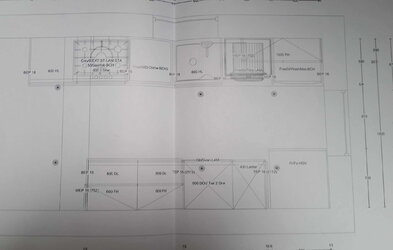
So I have had a look at the work my Electrician has advised and I am having extra sockets put in where the washing machine and tumble dryer are going, Moving the current socket so it can supply the Dishwasher. Having a new socket where the fridge freezer is going.

Grid switches for built in appliances also located along side the double sockets located next to oven housing. The grid switches will supply the appliances such as,
◦ Dishwasher
◦ Dryer
◦ Washing machine
◦ Fridge freezer

So someone mentioned earlier I don't need grid switches as well as sockets? I just assumed the grid switches would allow me to turn off the power to the socket and then I would be able to pull out the appliance.

I was only concerend where to locate the sockets so that the appliances do not jut out. I have attached a pic of the plan.
 

Attachments

  • kitchenplan.jpg
    kitchenplan.jpg
    108.4 KB · Views: 58
Ask 4 electricians a question and you will get 4 different sometimes correct answers.

Best to ask one electrician who is on site so he can give you advice. Remember it is advice only. The final decision is yours as long as it’s within the regs.

Then if your unsure of advice ask another what he thinks of that advice.

Otherwise your going to go round in circles.

I know what i would and do, do in kitchens, but accept there is more than one solution.

I quite liked the idea of the grid switches, but I only thought of it as a concern when someone mentioned it would overload the circuit?

My sparky is away on holiday so I am not going to bother him, it's not urgent.

Luckily the firdge freezer sockets can go low down where the freezer compressor is- quite a bit of space there to place the sockets in the void.

With the way the kitchen is designed there will need to be two double sockets under the sink cabinet. Is this going to be dangerous?

I am trying to work with the electrician and kitchen fitter to get the best solution and have everything discussed before we get one of those "oh $£%$" moments.
 
Personally I’m not keen on grid switches for the reasons already mentioned on thread. But I have fitted them at customers request.
Just ask your electrician to try and centralise grid to the ring as much as possible at that point. He will understand this anyway and probably will do so.

As for sockets under sink. No problem.

You are correct in trying to iron out and resolve possible problems at this stage.

Good luck.
 
I was under the impression that the current best practice/regs was to install plug and socket outlets in the cupboards for appliances so they can be disconnected individually from the supply easily for maintenance/repair/replacement
This also makes it much easier to upgrade and change appliances should the need arise?
These sockets can also be fed from a an FCU for additional means of isolation.....
 

OFFICIAL SPONSORS

Back
Top