G
Gardner
How does earth fault loop impedance and disconnect time requirements change for 3phase 3 wire 230 volt systems where the phase to earth voltage is 133 volts instead of 230 volts?
R= V/5In for a B type MCB. so you'd use 133V for the value of V.
Disconnection times only double to 0.8 s once the Uo decreases below 120V rms, so at 133 V rms the disconnection times will remain the same as for a Uo of 230 V.
However using Tel's formula above, decreasing Uo from 230 V to 133 V will reduce the impedance ( by a factor of 1.73).
So say for a 32 A type B BSEN60898 with a Zs at Uo of 230 V = 230 / 160 = 1.44 Ω
but for a 32 A type B BSEN60898 with a Uo of 133 V Zs = 133 / 160 = 0.83 Ω.
But only the Ze is known, the circuit isn't installed yet.
if you know the type and size of cable, work out R1+R2 from the milliohms/m x length.But only the Ze is known, the circuit isn't installed yet.
if you know the type and size of cable, work out R1+R2 from the milliohms/m x length.

You have a Ze value (lets say this is 0.3Ω). You are running a 30m long circuit from a 20A MCB type B to BSEN60898 at origin.
Your design voltage is Uo of 133 V.
PEFC(max) = Uo/Ze = 133 / 0.3 = 443.3 A
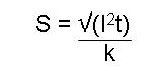
Adiabatic equation
View attachment 29333
From the graphs in appendix 3, 443 A is off the graph so take the instantaneous trip value of 100A and a time of 0.1s, k = 115
minimum csa for the protective conductor is 0.27 mm².
However the minimum size csa for a conductor in a power circuit from table 52.3 is 1.5mm² therefore 1.5mm² is fine.
Then you need to calculate volt drop on 20A design current (max) on 30m of 2.5mm² line conductor and neutral conductor = 18mV/A/m *20A*30m = 10.8 V this is less than 11.5V max for power so you are OK.