What type of cable and is it buried in the wall less than 50mm deep at any point?

RCD protection is not required for fault protection in this case, it's not a domestic lighting circuit and presumably the charger isn't in a bathroom so those aren't relevant.

The requirement for RCD protection of the outlet is covered by the unit itself.
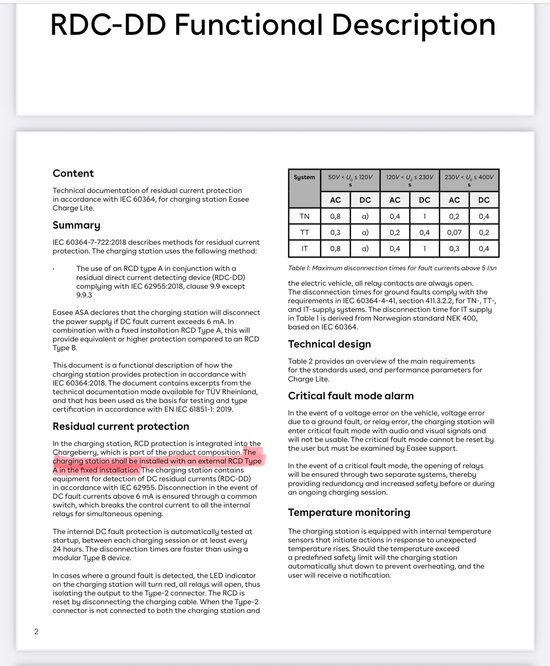
The charging station shall be installed with an external RCD Type
A in the fixed installation.
 
The charging station shall be installed with an external RCD Type
A in the fixed installation.
That is what the Easee functional description of the RDC-DD says.
But it is not what the Easee charging point installation instructions say (at least the copy I read)
Part of the confusion is that Easee seem to have updated their documentation in the period Dec 24 to May25.

Including the Type A RCD in the fixed installation would surely be the way to go.

PS grumpyjohn01 was referring to installation of an ASHP where it probably required a type B device.
 
That is what the Easee functional description of the RDC-DD says.
But it is not what the Easee charging point installation instructions say (at least the copy I read)
Part of the confusion is that Easee seem to have updated their documentation in the period Dec 24 to May25.

Including the Type A RCD in the fixed installation would surely be the way to go.
I would go along the lines of :

Regulation 722.531.3.101 of BS 7671:2018+A2:2022 states that unless the circuit is supplied using the protective measure of electrical separation, each charging point incorporating a socket-outlet or vehicle connector complying with the BS EN 62196 series is to be protected individually by an RCD of Type A, Type F or Type B and having a rated residual operating current not exceeding 30 mA. The RCD is also required to disconnect all live conductors.
 
Where have you got that from?

The OP has stated the charging point includes a B type RCD so any upstream RCD device must also be B type to function correctly and therefore comply.
Possibly my post #13 which quotes Easee's documentation on Residual Current protection, dated Dec 2024. The discussion subsequently turned to whether an RCD would be required at all at source.
If the charger already embodies an RDC-DD, why would a type B RCD also be required at the source of supply?

IMG_0008.jpeg
 
Last edited:
If the charger already embodies an RDC-DD, why would a type B RCD also be required at the source of supply?

If the cable is buried in a wall less than 50mm deep and does not have an earthed metal protection of some sort it would be required.

Or, not applicable in the OP's case but may be for others, and RCD is required for fault protection.
 
If the cable is buried in a wall less than 50mm deep and does not have an earthed metal protection of some sort it would be required.

Or, not applicable in the OP's case but may be for others, and RCD is required for fault protection.
Agreed - these points were made in the admittedly rather long thread above.

Having established that a (double pole) Type A RCD or RCBO seems to be needed, I just wondered why Type B was mentioned - that's all I meant!
 
Agreed - these points were made in the admittedly rather long thread above.

Having established that a (double pole) Type A RCD or RCBO seems to be needed, I just wondered why Type B was mentioned - that's all I meant!

The OP stated that the EVCP has a type B RCD in it, so we must assume that type B protection is required.
 
The OP stated that the EVCP has a type B RCD in it, so we must assume that type B protection is required.
The OP thought it had a type B RCD in it.
It transpires it's an RDC-DD.
According to the manufacturer it requires Type A protection in the supply.
I appreciate if you haven't read all the thread this might not be clear!
 
Last edited:
Crikey, so is my only option here to take up 3 ways in the consumer unit. A type B RCCB (2 ways) fed by an MCB?
HappyHippyDad - If you haven't got fed up with this thread by now, and already turned down the job, you might be coming to the conclusion it's not perhaps as bad as you thought..

My understanding (and this might be wrong!) is that you could use a Fusebox single module width 'miniature' double pole Type A RCBO at the CU
That's assuming you are not faced with contradictory instructions accompanying the charger!
I didn't get the quote! :D

I had a sneaky feeling that they just wanted a cheap job. I very much doubt the next electrician will look into like I have in order to do a proper job. Still, you get what you pay for. it's good to lose a quote every now and then, shows your not too cheap..

Many thanks to all those who took the time to reply. You always learn something. I have learnt that I need to look into the RCD BS conformities with regards the internal RCD's of EVCP's the next time I fit one.
 
Client just bought new car and has been supplied with one of these, and wants a 32A commando socket fitted!
A 32A interlocked RCD protected socket has been asked for but do they comply?

I think this has been aired before but cant find any details so reviving this old post about EVCP.
IMG_0564.jpeg
 
Client just bought new car and has been supplied with one of these, and wants a 32A commando socket fitted!
A 32A interlocked RCD protected socket has been asked for but do they comply?

I think this has been aired before but cant find any details so reviving this old post about EVCP.
View attachment 125160
Technically I believe they don't strictly comply with BS7671 when used in domestic because they are not shuttered though personally I think the interlock ones would be safe but you would be taking that engineering judgement on board if you fitted it.

I think the correct wording would be a departure from BS7671 that you would sign off on.

Its a bit of a grey area though seen lots of them installed by electricians on their YT videos.
 

OFFICIAL SPONSORS

Back
Top