Whenever I replace showers or lights or anything in a bathroom I always ensure its on a RCD, the Mira showers I've fitted recently say RCD in the instructions. Even like for like on bathroom lights, I tend to walk away unless I can get it on an RCD, more often than not you can just move an MCB to the protected side if the board, but failing that I say fit an RCD or get someone else to do it. Sounds a bit extreme I know, just feel better knowing it's protected, as others say where water and electric is involved it makes more sense.
 
Interesting issue and I dont know the answer so someone of higher knowledge than me please explain the rationale.

Original shower fitted without RCD protection (assume correctly to regs at that time) and identical shower now fitted to replace 'old' shower on a "like-for-like" basis (assuming they can still be sourced) but manuf instructions for the exact model now require an RCD whereas it didn't before (again assuming RCD's were being used then).

Can you claim replacement on a "like-for-like" basis as the current regs allow (and as instatallation was totally acceptable by the manufacturer originally for that model) or do you need to upgrade to current stds as if fitting new per manufaturers instructions? (i.e RCD protection).

Set aside that we all know that RCD protection is ideally the correct way forward for virtually anything that is fitted in the home, what is the actual position of what can or cannot be fitted to meet the regulations retrospectively?

Sorry if this is too deep an issue to be discussing on a Saturday night but as Im stuck at home baby-sitting I though I'd throw it in the pot to stop the rest of you lot going out and enjoying yourselves whilst Im remaining sober!!
 
what's wrong with 9.5kW on 6mm 40A as long as it's ref. method C?

What is 'ref. method C'? as I thought anything above 7.5kw needed to be on a 10mm feed? and 40A on a 6mm wouldn't the cable be burning out before the MCB trips? not trying to be clever just want to learn ;) or was your post sarcasm or something lol


Clipped direct is the high end of a cables rating
icon6.png


What is 'ref. method C'? as I thought anything above 7.5kw needed to be on a 10mm feed? and 40A on a 6mm wouldn't the cable be burning out before the MCB trips? not trying to be clever just want to learn ;) or was your post sarcasm or something lol[/QUOTE]

Tel sarcastic ? no not at all he doesn't know the meaning of such traits(thats one beer for one lie Tel)
icon11.png


The figures he suggested are indeed bordering on the reality of cable selection
 
Method 'C' = clipped direct (i.e. on the wall without any covering.)

7.5kW = 33A (@230V) which if to method 'C' in T&E = 4mm (excluding any factors for grouping etc... )

For 9.5kW take that as 41A and as 6mm T&E can handle 47A (excluding grouping etc.. ) a 40A breaker would be more than adequate --- exactly as Telectrix suggests!

Damn this baby-sitting thing, Im boring myself with calculations!
 
What is 'ref. method C'? as I thought anything above 7.5kw needed to be on a 10mm feed? and 40A on a 6mm wouldn't the cable be burning out before the MCB trips? not trying to be clever just want to learn ;) or was your post sarcasm or something lol
time to pick up some books methinks...

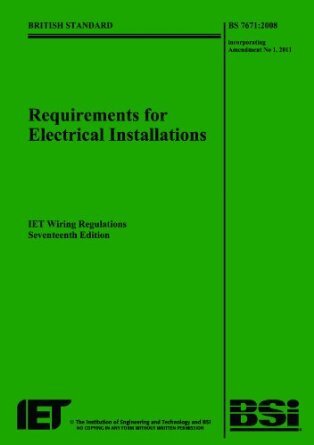
you could make a start with this:

419pq1dhQfL__SY445_.jpg
 
Interesting issue and I dont know the answer so someone of higher knowledge than me please explain the rationale.

Original shower fitted without RCD protection (assume correctly to regs at that time) and identical shower now fitted to replace 'old' shower on a "like-for-like" basis (assuming they can still be sourced) but manuf instructions for the exact model now require an RCD whereas it didn't before (again assuming RCD's were being used then).

Can you claim replacement on a "like-for-like" basis as the current regs allow (and as instatallation was totally acceptable by the manufacturer originally for that model) or do you need to upgrade to current stds as if fitting new per manufaturers instructions? (i.e RCD protection).

Set aside that we all know that RCD protection is ideally the correct way forward for virtually anything that is fitted in the home, what is the actual position of what can or cannot be fitted to meet the regulations retrospectively?

Sorry if this is too deep an issue to be discussing on a Saturday night but as Im stuck at home baby-sitting I though I'd throw it in the pot to stop the rest of you lot going out and enjoying yourselves whilst Im remaining sober!!


Call it progress or in sparky speak - a job = cash = profit
 
At the end of the day, don't look for a reason not to fit an RCD, just do it, it will have genuine safety benefits. I wouldn't fit a shower without RCD protection these days.
 
iam going too fit an rcd and told the costumer that but i didnt want to tell them it has to have and rcd to comply with current regs and then they google it or ask another spark and they say it doesnt , its that type of customer
 
if the shower instructions specify a RCD, then you got him by the short and crabbies. just show him the instructions.
 
iam going too fit an rcd and told the costumer that but i didnt want to tell them it has to have and rcd to comply with current regs and then they google it or ask another spark and they say it doesnt , its that type of customer

Thats the problems you will encounter on these forums for every question raised -- you will get a mirad of opinions and ways of doing things. However, remember there is a minimum standard that is totally acceptable to meet current regulations (not just BS7671), which if you adhere to will prove your defence in a court of law should the unthinkable happen. I stress that these offer a "minimum standard", which has been set by a band of 'experts' in the field. There is nothing stopping you exceeding this and removing every single bit of risk you can possible think of. Unfortunatley, as self-employed, you are in business to make money and 'exceeeding' general cost you more time and money!. For me thats the key difference between being self-employed and employed, the self-employed tradesman doesnt have a guaranteed source of income that the employed tradesman has!!

The regulations are the minimum baseline, regardless of what others may state on here --- if they feel they have a better solution then they can air this through the various committes out there and get things changed for the better.

Im not for one instance suggesting that any of the advice give on the forum isnt correct, safer, more practicable, or even is some cases better than standards/regulations! But if you take it do so at your own risk. In a court of law being able to show you followed the guidelines of relevant regulations/standards which have been set by "experts in the field", will prove much more effective of a defence than, "I was advised by an expert on the electricans forum who stated .........". Unless of course you can call him as an "expert witness" in your defence and he can prove the relevant standard/regulations were a load of horse sh*t.

As with all things in life, as an electrician you have to seek guidance, assimilate all the information given you, weed out the crap, take on board the good, add your own thoughts then relate it to how it fits into regulations/standards etc ..... for the job you are doing. Then and only then do you actually do anything!

edit: forgot to add, and accept that we ALL make mistakes at varying points in our careers ....
 

OFFICIAL SPONSORS

Back
Top