B

Barry White

Last edited by a moderator:
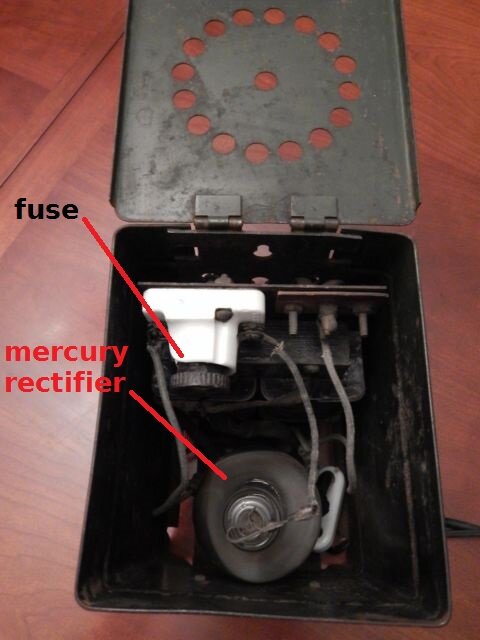
Before the advent of the silicon junction diode rectifying AC into DC was a major headache for higher current applications like battery chargers. Vacuum tube rectifiers were great for low current electronic items and mercury rectifiers were the norm for higher power. 1020's might be a bit early, if it is a mercury arc rectifier I'd guess it's from the 30's or 40's but @Lucien Nunes would probably give you the best guess.
 
I used to have, maybe still have somewhere a 13A socket with a spark free switch. It consisted of a switch which you turned which then moved a mercury filled glass tube which had fine braided wires at one end. As the glass tube turned the mercury shorted across the braids to energise the socket.
 
We use mercotacs in the machines we have instead of slip rings but they look boring just a bearing with terminals on. The mercury inside is the moving contact and therefore does not wear out.
 
That does look like a Tungar bulb but not all Tungar bulbs contain mercury. The trademark 'Tungar' stands for Tungsten-Argon and some types use only argon gas, some use mercury and some a mixture. It's not a Mercury Arc Rectifier because there is no arc - its cathode is a tungsten filament rather than a hotspot on a pool of mercury - so it is either an argon or mercury vapour rectifier.

Vapour-filled and arc rectifiers both have much lower forward voltage drop than vacuum thermionic (valve) types because the ionised gas eliminates most of the space-charge potential. The arc rectifier can handle much higher currents and has a longer theoretical working life, but is much more complex as it requires control-gear to start the arc etc, so not used for small domestic style chargers.

Mercury switches and relays are fun and useful, they offer long working lives even with frequent switching although can only be used right-way-up. They can have special functions such as time delay (mercury flows through capillary tube), sequenced multiple contacts etc. Some of the old animated illuminated signs e.g. with letters that lit in sequence to spell a word, used a row of mercury switches operated by a camshaft, as they could withstand the thousands of switching cycles per day. The type of socket Westy mentions may have come from an operating theatre or other location where an explosive atmosphere may occasionally be present.
 
Do you think I can find it, I suspect you are correct Lucien it is a fine bit of engineering made from lacquered brass.
 

OFFICIAL SPONSORS

OFFICIAL SPONSORS

Thread statistics

Created
Barry White,
Last reply from
dmxtothemax,
Replies
6
Views
2,501
Back
Top