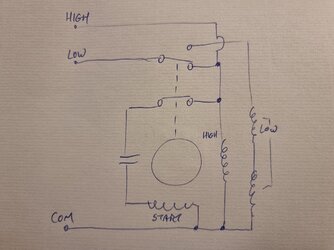
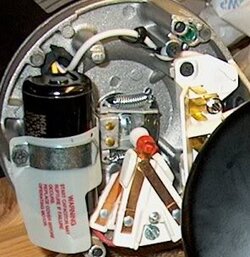
No, check out my diagram in post 6 and note how the centrifugal switch has two sets of contacts. When the motor is at rest, the lower (normally closed) contacts complete the circuit to the start winding in the usual way. The upper (changeover) contacts divert the low speed input to the high speed winding.
Suppose the motor is stopped and you apply power to the low speed input. The changeover contact routes the power to the high speed and start windings, and the motor starts. As soon as the centrifugal switch trips, i.e. before the motor even reaches high speed, the changeover contact re-routes the power back to the low speed winding. You would not even be aware from the outside that the motor had used the high-speed winding to achieve the start, it would seem to have gone straight to low speed.
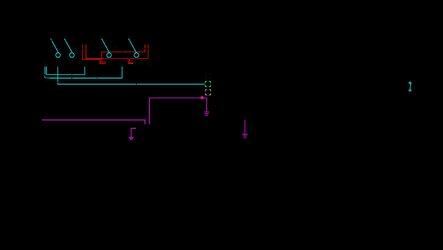
The A. O. Smith patent shows a different switching circuit that does exactly the same thing. I would guess they did it that way either because the simpler centrifugal switch saves a few cents over the cost of the triac, or to work around a patent on the changeover contact held by another manufacturer, or even to prevent another manufacturer working their way round Smith's own patent on the changeover contact.Hoping i interpreted you correctly?
No, check out my diagram in post 6 and note how the centrifugal switch has two sets of contacts. When the motor is at rest, the lower (normally closed) contacts complete the circuit to the start winding in the usual way. The upper (changeover) contacts divert the low speed input to the high speed winding.
Suppose the motor is stopped and you apply power to the low speed input. The changeover contact routes the power to the high speed and start windings, and the motor starts. As soon as the centrifugal switch trips, i.e. before the motor even reaches high speed, the changeover contact re-routes the power back to the low speed winding. You would not even be aware from the outside that the motor had used the high-speed winding to achieve the start, it would seem to have gone straight to low speed.
The A. O. Smith patent shows a different switching circuit that does exactly the same thing. I would guess they did it that way either because the simpler centrifugal switch saves a few cents over the cost of the triac, or to work around a patent on the changeover contact held by another manufacturer, or even to prevent another manufacturer working their way round Smith's own patent on the changeover contact.
Hoping i interpreted you correctly?