O

opyate

Hello,
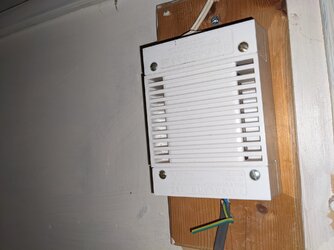
We moved into an old house (Wimpy 1957) and the doorbell doesn't work.
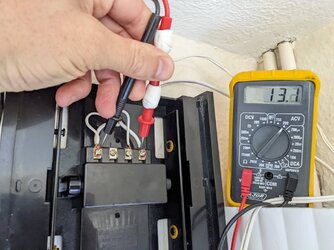
I read the AC voltage on the old Friedland 752 transformer, and it's at 13V, not 3 or 5 or 8 as per the options. The solenoid on the bell might be getting too much power.

Why might it read 13V?
This person also found theirs to read 13.8V, so I wonder if the Friedland breaks in specific ways, or we share the same underlying issue: https://friedland-752-manual.peatix.com/
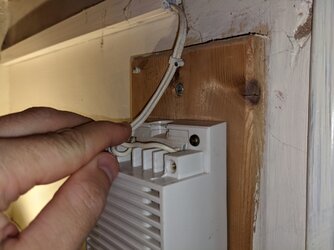
 

Attachments

  • PXL_20220905_174138539.jpg
    PXL_20220905_174138539.jpg
    304.4 KB · Views: 27
  • PXL_20220905_174031165.jpg
    PXL_20220905_174031165.jpg
    291.7 KB · Views: 26
  • PXL_20220905_173333172.jpg
    PXL_20220905_173333172.jpg
    321.1 KB · Views: 25
what is the voltage you get at the chime, when the bell push is operated?

If its nothing... then there's a break somewhere, and the chime isn't getting any voltage... 8 or 13

What voltage do you get between the other terminals? you could move the wires over to give what you're looking for.

bell push buttons are notoriously susceptible to rust... being outside all the time.
Take the bell push apart... clean the contacts...and even test the circuit by touching the wires together...
 
Hello,
We moved into an old house (Wimpy 1957) and the doorbell doesn't work.
I read the AC voltage on the old Friedland 752 transformer, and it's at 13V, not 3 or 5 or 8 as per the options. The solenoid on the bell might be getting too much power.

Why might it read 13V?
This person also found theirs to read 13.8V, so I wonder if the Friedland breaks in specific ways, or we share the same underlying issue: https://friedland-752-manual.peatix.com/
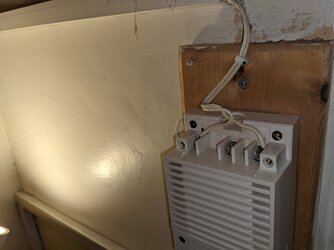
The voltage you are reading is the no load voltage once you have the chime working when the bell push is pressed the voltage will drop down
 
what is the voltage you get at the chime, when the bell push is operated?

If its nothing... then there's a break somewhere, and the chime isn't getting any voltage... 8 or 13

What voltage do you get between the other terminals? you could move the wires over to give what you're looking for.

bell push buttons are notoriously susceptible to rust... being outside all the time.
Take the bell push apart... clean the contacts...and even test the circuit by touching the wires together...
Thanks for the reply 👍

The doorbell button itself is in perfect working order (1 when not pressed, and 0 when pressed, on my conductivity meter).

The doorbell itself gets 13.2V from the transformer (again, the transformer is supposed to deliver 3, 5 or 8V).

I've uploaded a video of the buzzing noise the doorbell makes when the button is pressed. Getting too much voltage, perhaps? Or the chimes are stuck and not getting pulled towards the solenoid?


Attachments

  • PXL_20220907_174314877.MP.jpg
    PXL_20220907_174314877.MP.jpg
    389.3 KB · Views: 18
Thanks for the reply 👍

The doorbell button itself is in perfect working order (1 when not pressed, and 0 when pressed, on my conductivity meter).

The doorbell itself gets 13.2V from the transformer (again, the transformer is supposed to deliver 3, 5 or 8V).

I've uploaded a video of the buzzing noise the doorbell makes when the button is pressed. Getting too much voltage, perhaps? Or the chimes are stuck and not getting pulled towards the solenoid?

Does the arnature that strikes the 2 chimes move freely or is it jammed
 
Does the arnature that strikes the 2 chimes move freely or is it jammed
(Apologies for the late reply. I only remember to reply when I get home, but this forum is unusable on my mobile. At work PC now, so much better.)
I don't see any movement (e.g. in the video I posted earlier), but I'm not sure how this particular bell is supposed to work.
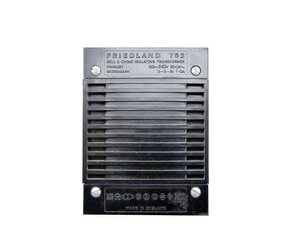
I'm mostly concerned about the transformer reading 13V, and not 3 or 5 or 8 as per the options on the diagram.

I'd like to get a new bell, but don't want to ruin it with too-high voltage. Do you think getting a new transformer is also a good idea?
 

Attachments

  • friedland.jpeg
    friedland.jpeg
    99.2 KB · Views: 12
I'm mostly concerned about the transformer reading 13V, and not 3 or 5 or 8 as per the options on the diagram.
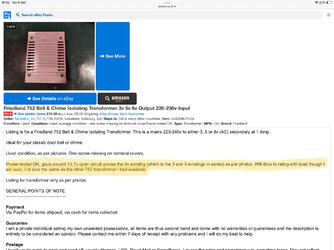
All the signs are that 13V is the normal off-load voltage across all the windings. See below listing by "Hellzbellz" who's sold a couple on eBay with the same feature. I don't think the 13V represents a fault.

.D136B968-956A-493A-9BC7-0855F63A77CE.jpeg
 

OFFICIAL SPONSORS

Back
Top