oracle

~
Arms
The least I have ever seen is an ordinary continuity / insulation resistance tester and a roll each of pass / fail stickers and the guy did a damn good job.

What do you think we should carry and why ?
 
I don't have a bag.... I am bagless ...
I have pens and a mouse... ooooooh and a stapler...
 
Oracle, I assume you are asking the question ISITEE specific as it is in this sub forum.

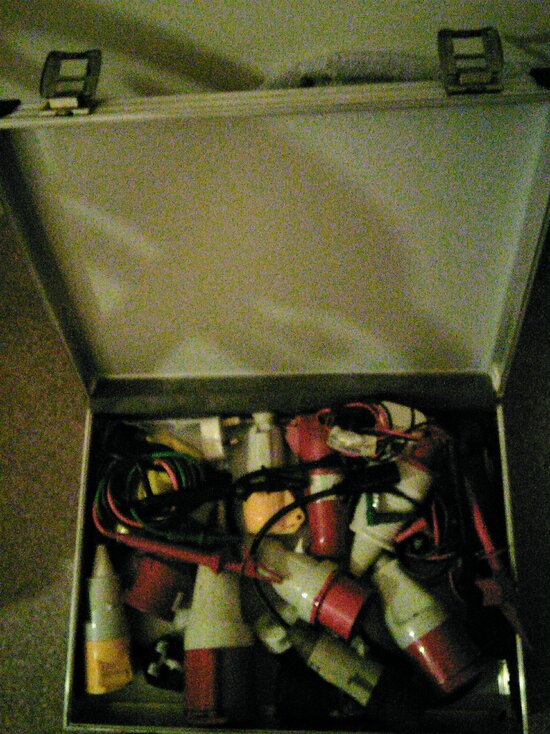
Apart from the obvious things, this will vary depending on what industries you test within. For example, we do most of our ISITEE within the entertainment industry and have a large collection of different short jumpers and mounded adaptors for the various connectors and inlets that we see regularly, but you may never see if just doing offices.

An isolation transformer for testing of plugtop type RCDs is a useful addition for anyone doing ISITEE regularly.
 
9 screwdrivers, hammer, 3 files, 2 slip joint pliers, 2 adjustable wrenches, standard pliers, needle nose pliers, ratchet crimper, spirit level, chalk line, draw tape, 5 spanner’s, center punch, a couple of podgers, set square, measuring tape, standard hack saw, juinior hack saw, cable cropper, side cutters, some drill bits, various crimps, some long 3.5mm screws, marker pens, volt stick, couple of pencils, pencil sharpener, some screw driver bits, an old paint brush, various hole saws, pad saw, then whatever else you might need for specific jobs.
 
Oracle, I assume you are asking the question ISITEE specific as it is in this sub forum.

Apart from the obvious things, this will vary depending on what industries you test within. For example, we do most of our ISITEE within the entertainment industry and have a large collection of different short jumpers and mounded adaptors for the various connectors and inlets that we see regularly, but you may never see if just doing offices.

An isolation transformer for testing of plugtop type RCDs is a useful addition for anyone doing ISITEE regularly.

Hi Tony

Thank you for your responsible reply
I did start the thread seriously but it only drew lighthearted responses so I gave up.
Your work sounds extremely specialised ,so I imagine it's better paid than ordinary, so called PAT testing?
 
IMG_20180907_054752.jpg
9 screwdrivers, hammer, 3 files, 2 slip joint pliers, 2 adjustable wrenches, standard pliers, needle nose pliers, ratchet crimper, spirit level, chalk line, draw tape, 5 spanner’s, center punch, a couple of podgers, set square, measuring tape, standard hack saw, juinior hack saw, cable cropper, side cutters, some drill bits, various crimps, some long 3.5mm screws, marker pens, volt stick, couple of pencils, pencil sharpener, some screw driver bits, an old paint brush, various hole saws, pad saw, then whatever else you might need for specific jobs.

I was thinking of equipment testing kit and accessories, obviously some hand tools are required, but personally I carry a lot of adapters for testing commercial and industrial equipment and cables Picture attached is my adaptor box
 

OFFICIAL SPONSORS

Back
Top