Hi Guys sorry been a tad busy trying to sort this out to reply often enough but I'll try answering some of the questions .I have just read some posts in the iet forum about mice finding their way into trunking, busbars and switchgear and ‘setting up home’ with baby mice appearing in due course because the TV reception was lousy.
It might be an idea to just open up the switchgear and trunking to see what might be going on Inside.
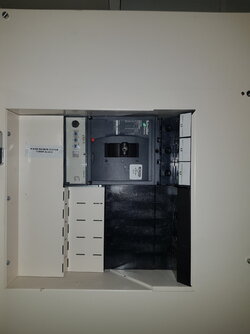
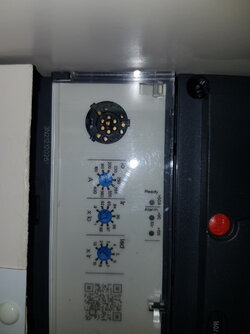
A few high-current faults and that happens, contact life can be as low as a few dozen and max rated breaking. It points to the faults being way over 1.9kA though.The 400amp MCCB which incidentally has fried today is a Siemens see photos.
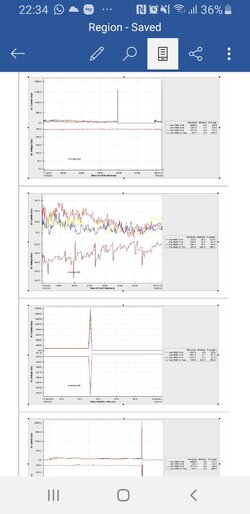
Thanks for that info. I've replaced the MCCB again this morning and re- energised and now that the DNO have monitoring I'm hopeful of a resolution although I'm expecting my phone to ring at about 2.00ish in the morning. I'll keep you updated when I get some results back from my monitoring or the DNODaveh36. Thank you for the update on this interesting to me yet fraught for you problem. Looking at the voltage and current plots it seems to me that there is a spike of voltage upwards to 272V immediately followed by a spike in current in all three phases. I wonder if the problem is on the incoming supply side ie causing the spike upwards of 22V but it is troublesome to the block's electricity installation because this very short spike when presented across a very low surge impedance inevitably results in a momentarily very high surge current in all three lines. I mentioned before it may be some quirky trick of fate that the supply impedance connected in series with the building wiring surge impedance are resonating at one of the frequencies excited by the spike. You know that at series resonance the current is only limited by the copper Ohmic resistance which may be very very small because the block is close to the supply transformer and only fed by a short cable. With such large currents flowing there will be significant short term overvoltages which may lead to flashover between exposed copper conductors and effectively a three lines short circuit until the fuses rupture.
Why the voltage disturbance happens may be because of an upstream transformer tap change to regulate network voltage.
I think you could sensibly press the DNO to investigate this observation. The coincidence of the voltage spike, on all three phases and generally overnight at the same time. pc1966 mentioned you should check the peak current specification of the current clamps and analyser because the recorded spike may well be much higher than 2kA.
Really this looks like a bigger fault inside the installation!Thanks for that info. I've replaced the MCCB again this morning and re- energised and now that the DNO have monitoring I'm hopeful of a resolution although I'm expecting my phone to ring at about 2.00ish in the morning. I'll keep you updated when I get some results back from my monitoring or the DNO
Think I'm a little wiser than to work with out turning the MCCB off but hey.Really this looks like a bigger fault inside the installation!
What does the MCCB feed?
How is it cabled?
How are the flats fed from the main supply?
However, if you are going to inspect stuff please make sure the supply MCCB is off! You really do not want to disturb something with a history of high kA faults as it can lead to life-changing or life-ending injuries!
Its a public forum, we can't assume anything!Think I'm a little wiser than to work with out turning the MCCB off but hey.
It would take a very high level of lightning hit to trigger an arc, and this is not a country that sees that every day!There are 66 apartments spread over the 12 floors. Rising main with tap off box ever other floor feeding fuse cabinets for the apartments. Which are in turn fed via split concentric to individual boards. Bear in mind these were fitted around 9 years ago so no surge protection. Interestingly though I was informed today that the apartment block next door it one had power outage yesterday as well might be coincidental but who knows
Very true the regular timing of the fault suggests something is a trigger for it.pc1966: I don't feel so ready to dismiss something on the DNO side of the fuses because the timing and regularity of the outages hints at something happening during the quieter hours or lower load periods - so something being done for technical reasons and necessary during these periods and regularly. My money now is on a DNO overvoltage mechanism triggering a busbar arc fault perhaps at an insulator defect. (I discovered by the way high current arcs between busbars tend to move away from their point of initiation due to the usual electrodynamic forces at play.) As ever I could be wrong...
Yes, a very depressing event all roundI got myself immersed in this problem to avoid the miserable news about what is happening in Ukraine. This is what I read this afternoon:
https://www.studiecd.dk/cahiers_techniques/Fault_arcs_on_busbar_sets_and_switchboards.pdf